

Why Do Doctors Hate Checklists?
The real culture war in healthcare

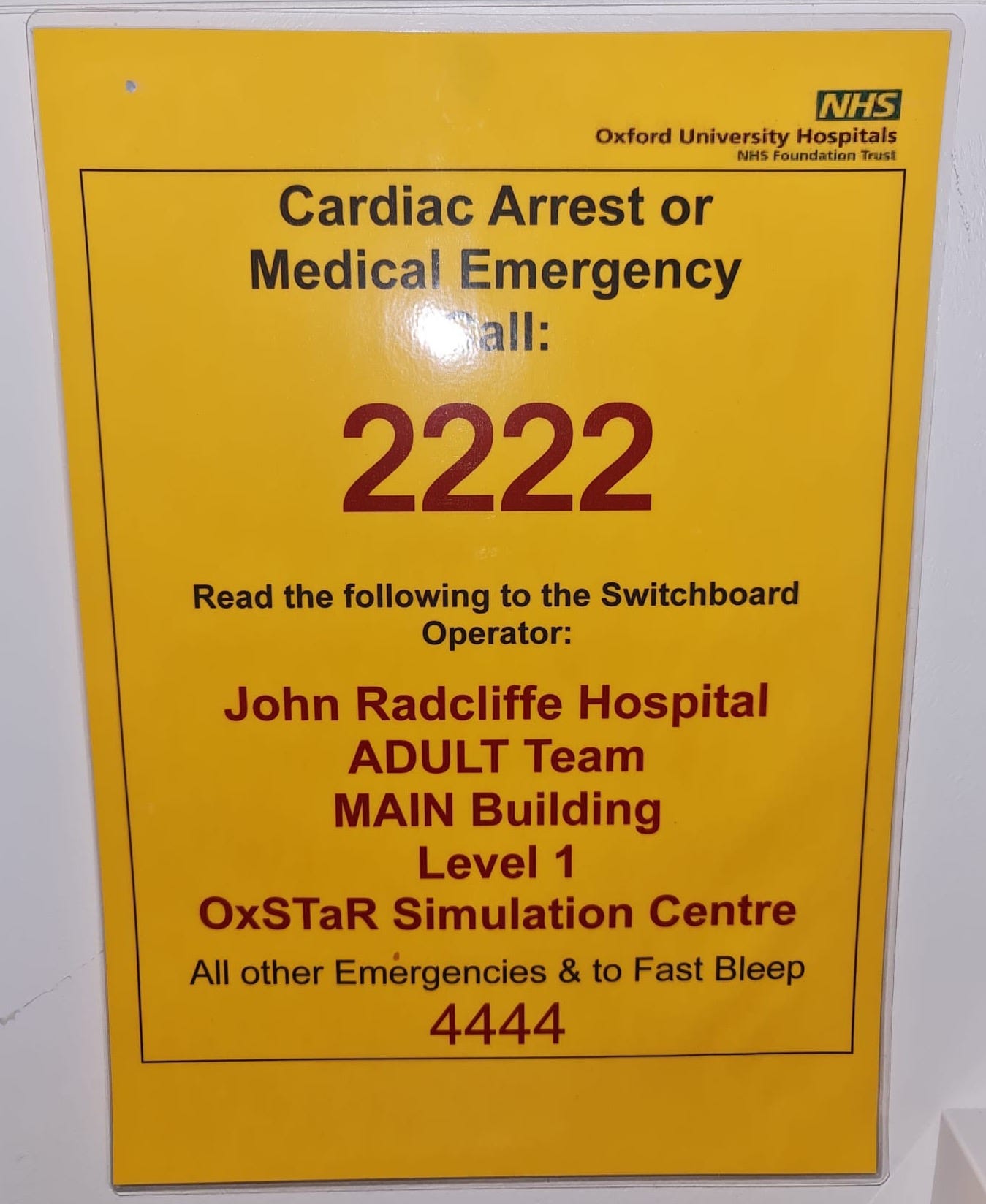
I used to enjoy resuscitation training. Every two years we would trog over to the little simulator room in the resus department and run through cardiac arrest scenarios. An added highlight was being trained alongside doctors from every corner of the hospital. A colleague of mine once got paired up with a consultant in genitourinary medicine, so he walked up to his ‘patient’, shook his head and said: “I’m afraid we’ve got a goner ‘ere!”
As double-hard anaesthetists we would swagger into these sessions, amused by the look of utter terror on the faces of doctors from less acute disciplines. But of course, the consultant in genetics or theoretical neurology had been furiously revising for weeks and absolutely smashed it in the assessment, whereas I, in my hubris, would arrive unprepared and would cock it up completely. Things I thought I knew would disappear in the heat of battle. Funny, that.
In our trust, next to every phone, there is a laminated sign like the one above. They’re there because during an emergency, panicking staff would often make mistakes when trying to call the crash team – like calling for the wrong team or sending them to the wrong location. It’s a checklist for making a phone call, and it works. Yet: when you turn up to manage the arrest – actually treat the patient with dangerous drugs and whatever - you are expected to do everything from memory.
Just think about that. We don’t trust you to know which ward you work on or whether your patient is an adult, but all those H’s and T’s and the precise sequence of this year’s protocol? Yeah, off you go mate. You’ll be fine.
There’s a human factors term for this: it’s ‘bollocks’.
We need to get over our pathetic cultural resistance to checklists. There is this macho idea we’ve inherited that says everything you do should be done from memory or you’re no good. This is antediluvian garbage, long abandoned in every other safety-critical industry. I have a pilot friend who was marked down in his simulator assessment because he did a manoeuvre – quite correctly – but from memory rather than from the checklist. Which seems harsh until you realise that British commercial aviation hasn’t killed a passenger for 36 years.
To see a perfect example of healthcare’s allergy to this proven safety tool, look no further than its one successful implementation: the WHO surgical safety checklist.
This is a standardised procedure where the operating theatre team hold meetings and collectively confirm certain trivial details, like, I dunno, whether they’re about to do the right operation on the right patient. There is a huge body of evidence showing its beneficial impact on complication rates and mortality, so obviously, we all had to be dragged kicking and screaming by the hair before we co-operated.
I observed in real time what I call the ‘compliance curve’ of the WHO checklist roll-out into the NHS. It can be broken down into phases, not unlike the stages of grief.
Phase 1 is ‘anger’. Basically a load senior people reacting as though it were an apocalyptic threat to their clinical freedom while also broadcasting that they’re far too busy and important for this ‘management nonsense’.
Eventually, this gives way to Phase 2: ‘petulant acquiescence’. This is where the nurses, who are better at following rules than we are, badger us to comply, which we do with all the grace of a teenager being made to do the washing-up.
Phase 3 is ‘comedy’, which can be summarised as “we can’t stop this happening, but we sure can take the piss out of it!” Part of the WHO checklist involves each team member stating their name and role, where, according to one wag “we introduce ourselves to people we have worked with for years, and, in some cases, are married to”.
I enjoyed the ‘comedy’ phase. It was my favourite phase. “My name’s Doctor Hambly and I’m an alcoholi-, I mean, anaesthetist. Whoops – wrong meeting! Haha”.
That was pretty hilarious the first eighteen times, let me tell you.
After ‘comedy’, we turn a corner. Phase 4 is ‘dependence’. People become used to the meetings, and although still outwardly cynical, they have started to realise their value, even if only subconsciously. So when they don’t happen, they’re suddenly lost. “Omigod, we haven’t done the WHO…”
Finally, after a year or two we reach Phase 5: ‘pride’. This is where the message has finally got through. I’ve seen big ugly senior surgeons, standing with the consent form, ostentatiously checking the patient’s wristband and verbally confirming that they tally, as if to say “in my theatre, we care about safety”.
What the WHO checklist has achieved goes far beyond the individual errors it may or may not prevent. It has done that thing that everyone says is impossible: it’s changed the culture. Without realising it, we’re all working better as a team: there’s better sharing of information, more speaking up, more cohesion. Safety has become a collective endeavour. And yet we had to wade through treacle to get here.
Checklists, like many other proven safety tools, remain horribly underused because Human factors in healthcare has a grassroots problem. The biggest single obstacle is not managers or budgets or politicians, it’s prehistoric attitudes among front-line staff. And if you can’t see this, you are part of the problem.